CATARINA MAC: AMERICAN SOJOURNER

CATARINA MAC: AMERICAN SOJOURNER CATARINA MAC: AMERICAN SOJOURNER CATARINA MAC: AMERICAN SOJOURNER
  • Home
  • Who?
  • Late'60s
    • Intro to 1967's Dailyaide
    • 1967 Q1 (Jan, Feb, Mar)
    • 1967 Q2 (Apr, May, June)
    • 1967 Q3 (July, Aug, Sept)
    • 1967 Q4 (Oct, Nov, Dec)
    • June to mid-August 1968
    • To Nova Scotia & Back
    • Back in School, Sept 1968
    • Oct. 1968, KC turns 15 !
    • Nov. 1968 & Early 1969
  • Oct'75-Aug'78
    • Introduction
    • Book I, Oct 1975-76
    • Book II, Jun-Oct, 1977
    • Book 3's Final Entry 1978
  • Late'80s
    • Journal 1: Jan-Mar 1988
    • Journal 2: Mar-Sept 1988
  • Themes
    • Childhood & Parents
    • Motherhood
    • Art & Jesus & Life
  • 1991
    • Introduction
    • July '91
    • August '91
    • Sept & Oct '91
    • November '91
    • December '91
  • Reality
  • Feral Cats
  • Poems
  • Stories
  • Prayers
  • Contact
  • More
    • Home
    • Who?
    • Late'60s
      • Intro to 1967's Dailyaide
      • 1967 Q1 (Jan, Feb, Mar)
      • 1967 Q2 (Apr, May, June)
      • 1967 Q3 (July, Aug, Sept)
      • 1967 Q4 (Oct, Nov, Dec)
      • June to mid-August 1968
      • To Nova Scotia & Back
      • Back in School, Sept 1968
      • Oct. 1968, KC turns 15 !
      • Nov. 1968 & Early 1969
    • Oct'75-Aug'78
      • Introduction
      • Book I, Oct 1975-76
      • Book II, Jun-Oct, 1977
      • Book 3's Final Entry 1978
    • Late'80s
      • Journal 1: Jan-Mar 1988
      • Journal 2: Mar-Sept 1988
    • Themes
      • Childhood & Parents
      • Motherhood
      • Art & Jesus & Life
    • 1991
      • Introduction
      • July '91
      • August '91
      • Sept & Oct '91
      • November '91
      • December '91
    • Reality
    • Feral Cats
    • Poems
    • Stories
    • Prayers
    • Contact

CATARINA MAC: AMERICAN SOJOURNER

CATARINA MAC: AMERICAN SOJOURNER CATARINA MAC: AMERICAN SOJOURNER CATARINA MAC: AMERICAN SOJOURNER
  • Home
  • Who?
  • Late'60s
    • Intro to 1967's Dailyaide
    • 1967 Q1 (Jan, Feb, Mar)
    • 1967 Q2 (Apr, May, June)
    • 1967 Q3 (July, Aug, Sept)
    • 1967 Q4 (Oct, Nov, Dec)
    • June to mid-August 1968
    • To Nova Scotia & Back
    • Back in School, Sept 1968
    • Oct. 1968, KC turns 15 !
    • Nov. 1968 & Early 1969
  • Oct'75-Aug'78
    • Introduction
    • Book I, Oct 1975-76
    • Book II, Jun-Oct, 1977
    • Book 3's Final Entry 1978
  • Late'80s
    • Journal 1: Jan-Mar 1988
    • Journal 2: Mar-Sept 1988
  • Themes
    • Childhood & Parents
    • Motherhood
    • Art & Jesus & Life
  • 1991
    • Introduction
    • July '91
    • August '91
    • Sept & Oct '91
    • November '91
    • December '91
  • Reality
  • Feral Cats
  • Poems
  • Stories
  • Prayers
  • Contact

Now in Canada, KC continues her story with this entry from August 20, 1968 (a Tuesday)

She begins with some heavy black cross-outs and then writes:  

Pardon the cross-outs, I was just figuring something out.  Anyway, life in Canada is rather interesting.  Beautiful scenery, and the water isn’t bad. 

August 21, 1968 (a Wednesday)

    A green truck pulled up outside one of the front doors of the store where we had stopped to get me some milk.  Sacks of potatoes were piled, one on top of another, to be delivered to the restaurant next door. 

    A short man in a green jacket jumped out of his cab.  He knocked on the door of the restaurant peering through “Ice Cream - 15¢ ” and “Home-made Bread” which was written across the glass door in white letters.  A man came out, all in white, tying a white apron behind him, looking fattish, blond, and Scotch. 

    They talked for a few minutes and then the truck driver proceeded to unload his potatoes.  Small boys, everywhere there are small boys, stood around him, offering talkative help. 

                                   The 26th Step 

    Green hills, blue hills, red roads and rivers, dust spread on the sky like lumpy-thin frosting, this is New Brunswick. 

    The first day was, to put it accurately, ghastly, for me.  I caught the virus and I had chills all the way up to St. Stephen’s.  After 350 miles of highway, shining steel and construction, and later, great blue lakes and majestic hills set with birch trees and pine, and, most beautiful to me, the grey barns and houses, built with a special architecture all their own, after all this horror and beauty, I landed on a bed in a St. Steven’s hotel disguised as a warehouse, gasping like a fish out of water.  I had a fever. 

    Daddy got sick, too, and felt as ghastly as I had. 

    Somehow that night we crawled down the 26 steps of the hotel that led to the streets of St. Stephen’s.  (Bulletin: 1 mile to Nova Scotia !) 

    It seemed that most of the inhabitants of St. S. were gathering at the local movie theater.  Guess Who’s Coming to Dinner was playing.  Not far from there was the Pentecostal Society’s place, with a big sign “Jesus Saves”.  Behind one side of St. S.’ main street was a river of sorts.  The lights of the town reflected in the water blurrily.  I felt pretty blurry myself. 

August 23, 1968 (a Friday) - Part 1

   Well, I’ve been to Antigonish and Malignant Cove.  It’s beautiful.  Patchwork quilt fields, all shades of yellow, and great blue and green hills topped with Sistine chapel clouds, and beyond the hills the sea, sometimes red, sometimes olive-blue, but always flecked with white waves, far, far out to the horizon.  The fields and hills are lonely, with only brown and tan cows and horses and occasional grey-shingled houses as inhabitants. 

    The country-side is quietly royal and life is simple.  The few people we talked to were friendly, probably because of our name.  If one lived there, life would be not filled with entertainment, but rather, something of a higher order, perhaps it is beauty, or peace. 

    The hills are wild, the wind blows fierce, and the waves feed upon the shore.  Sunlight breaks through the clouds and sends a beam of light searching across the countryside like God’s finger searching a man’s soul. 

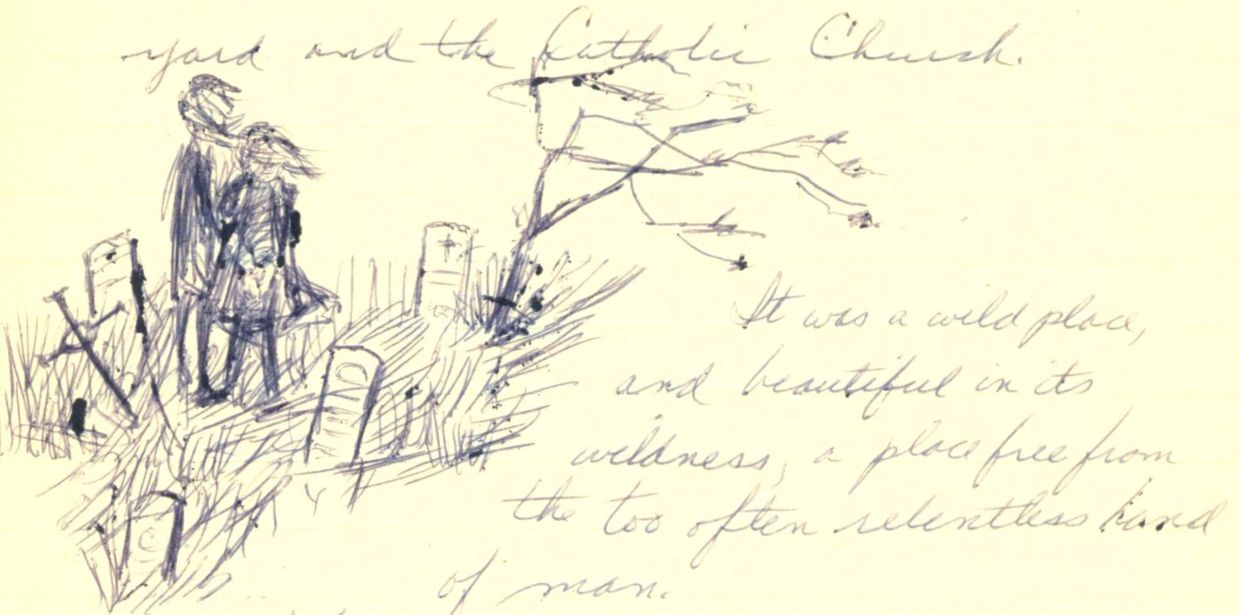
    We visited a graveyard in Georgeville.  Here many of my ancestors probably rest at peace.  There were Chisholms, MacKinnons, Ginnis's, and Mac Issac’s.  The ancient stones were set into the ground at angles with the hill, and there were old wooden crosses, some snapped at the base, and a few iron ones with no names.  The graves were above the level of the ground but it was so hilly there that one couldn’t be sure whether or not one was walking across a grave or some natural formation of the ground.  Complete with high, wild grasses and thorny bushes and the overcast sky, the graveyard presented a most interesting scene.  We scrambled over graves (I avoided the obviously most recent ones, preferring to step around them) trying to make out names and dates. 

    Some of the occupants had been there a hundred years.  There were small babies, and children of seven, a young boy of 23, and beloved husbands and wives all who had lived and died on the hills of Antigonish. 

    After that we crossed a long, winding dirt road to the Georgeville church.  Built in an architecture that we of New England would consider Protestant, the church was quite unlike the modern, highly abstract buildings that I am so familiar with.  For one thing, it had no stained glass windows.  Perhaps, as my mother said, the people had been too poor to afford them.  They (the windows) were square at the bottom and curved up to a point at the top. 

    The door was locked, so we walked along the side, peering in windows at the old-fashioned pews, divided into compartments.  The altar was rather fantastic with huge plaster statues of saints and angels seated on strategic points.  That must have been the old altar, for the new way of facing the people had made another, newer and simpler, altar necessary. 

    Then we went to the priest’s house, beside the church, a bit of yellow grass growing free between.  We had had hopes of asking the priest if we could look at the church records, but his sister, who was a nun, said he wasn’t home, but we could wait a few minutes, in what I suppose was their parlor.  The style was Old Irish Boston Apartment, with giant fake leather armchairs and footstools, religious pictures, including one of Pope Paul, the fireplace boarded up with a picture of the Last Supper in the middle, the wallpaper old and flowery, and the smell of cabbage8 or some such thing in the air, drafting down from the kitchen.  Lace curtains, and doilies on the chairs. 

    Father never came so we left our name and address and some historical information about ourselves so that the good man could spend the long winter hours digging in the parish records, which we had hoped to do ourselves. 

    But actually, that is more or less what we did the second day.  The first was rather interesting.  We stopped first at a small beach at Arisaig.  (I think that’s how you spell it.)   There wasn’t any resemblance to the Sunday beaches of the Cape, though.  It was wild, the wind howling, the sea beating the small patch of sand and the big mound of rocks, the sun only timidly daring to venture through the curtain of clouds shrouding the scene.  I sat on a rock that just met the slapping water and felt the spray on my face, misting my glasses.  I felt, for the first time in my life, that this was where I really belonged, this country was my home. 

    I have said, I know, many times, how much I love my home, and I do, but this place was different.  It was where I belonged.  Someday I shall go back, God willing. 

August 23, 1968 (a Friday) - Part 2

    We stopped to see if there was anyone about who could give us some information about the Chisholms and we were told to go “see Billy Malcolm Chisholm, up the hill a bit, but he’s a character.  He’ll probably talk to you if he isn’t drunk.” 

    Billy Malcolm was a character, allright.  Dad went in to talk to him while Mom, Eily and I waited in the car, surveying the scene.  Great yellow hills of blowing grass stretched out to meet green-blue pine trees, and beyond that, the pounding sea. 

    It was beautiful. 

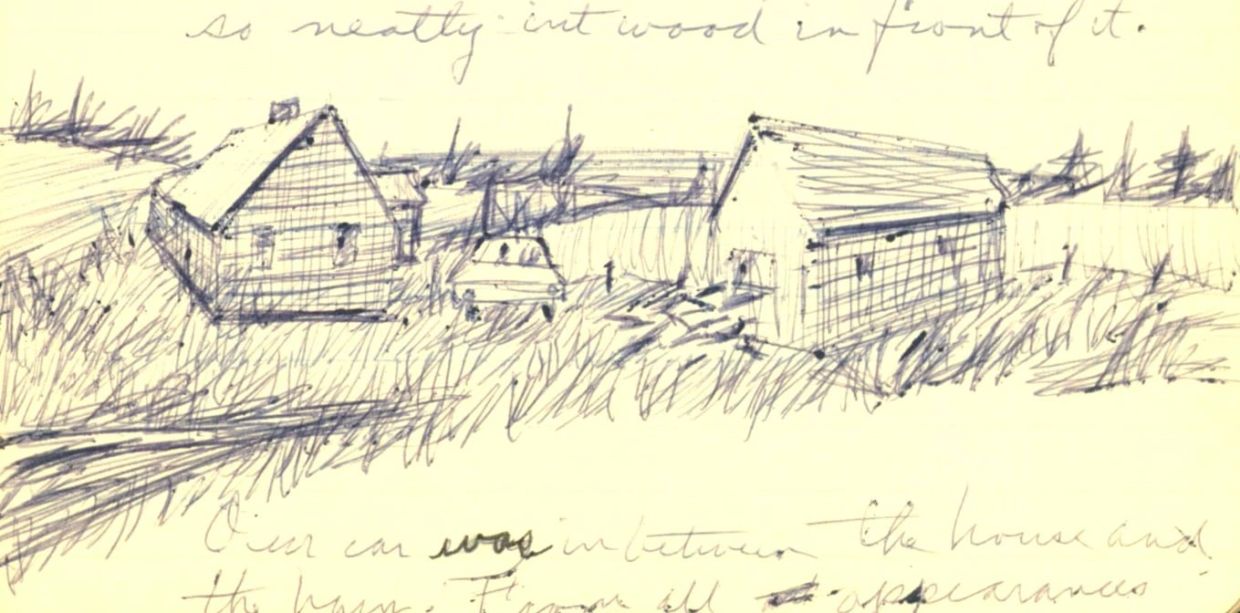
    I could see an old face looking out the window at us; Dad told us later, though, that there was a friend of Billy M.’s, too, so maybe that was who I saw.  The cottage (I call it cottage, because it reminds me of the grey-shingled cottages of the Cape, though it was probably bigger than one of those..) was weather-beaten and old looking.  Later, Dad told us that it had 8 rooms, though it certainly didn’t look it from the outside.  There was also a barn, and a pile of not so neatly cut wood in front of it. 

August 23, 1968 (a Friday) - Part 3

    Our car was in between the house and the barn.  From all appearances Billy Malcolm didn’t have a car, though heaven only knows how he got to the town of Antigonish to get his drink. 

    Our white car faced the hills and behind us was a very small hill covered with trees and at the bottom there was a cream brown cow, munching away.  Between our car and the hill the road (more likely dirt track) died out, that climbed up the steep hill like a pale brown snake, rutted and pocked and pimpled with stones.  In the spring it would probably be impossible to drive a car up there, for the mud. 

    Now, I better tell you about my great-grandfather, before I tell you what Billy Malcolm said.  In fact, I’d better go back further than that. 

    On April 16, 1746 the Highlanders were defeated at the battle of Culloden by the English army.  There were Chisholms on both sides.  Many of the defeated Scotch left the Highlands for Nova Scotia or other parts of North America.  As far as we can figure our ancestors were among them, but we think they came to Boston, first.  Then the Chisholms went up north to Nova Scotia, that is, Malignant Cove; quite possibly to that particular place because of its resemblance to the Highlands. 

    They got established up there. 

    Now, some time later my great-great-grandfather [gggf] had a son, my great-grandfather [ggf].  Now, my gggf was a Chisholm and my gggrandmother was a Chisholm, which makes my ggf as Chisholm as you can get. 

    Twelve years went by.  Sometime during those years my gggrandmother died.  My gggf remarried, but my ggf didn’t like her, his stepmother.  He ran away, to the Maine woods, worked there, and eventually came to Boston where he married an Irish girl named Bridget. 


    (One of the old man’s stories, which may be true, and I wonder why he would have said it, if there wasn’t some grain of truth in it, goes like this:  He was out in a snowstorm, riding on a wagon, probably, when he realizes he had lost his way.  Then he noticed a light behind his horse’s ear.  It moved and he followed it.  The light led him home, safely through the storm.

    This was shortly after his mother had died.) 


    Now then. 

    Billy Malcolm said there were six brothers, including my ggf.  At least two of them were sea captains.  One of the brothers went to Australia.  There was also a sister who came down to Boston, later.  And, oh yes, the boys were smart as whips, and the sisters were great singers.  (Now, is that a talent I inherited?)  

    My ggf must have run away before Billy Malcolm was very old, for he couldn’t tell us much about him.  B. M. had a trunk upstairs filled with old records and he invited us to stay and look them over and in fact, if we wanted, we could sleep overnight at his place. 

    “Oh, no, thank you just the same, but we already have a room at the Gael Motel.” 


    Personally, I think we should have stayed. 


    And then we rolled down the hill to the graveled, and even more elegant, road below, which stretched along over a brook of sorts, (where we got, of all things, a thistle, with great, sharp thorns.  Later it went to seed and I am going to plant them,) past the old church yard and the Catholic Church. 
August 23, 1968 (a Friday) - Part 4

    It was a wild place, and beautiful in its wildness, a place free from the too often relentless hand of man. 


    That was the first and second day, though I didn’t originally intend to mix them around like that. 

    We left and traveled along the Cabot Trail – It was nice, rather impressive, very postcard. 

   And we turned around and started back homeward.  We went along the Antigonish road and had one last look at Malignant Cove, the sun, not setting yet, but on its way, touching the countryside with a warm golden glow. 

    Then we drove on.  I’m not sure where our next hotel was, but if it’s the one I think it was all I can remember about it is that it was pale green (the outside) and I had a room of my own.  (What a relief!  On almost the whole trip Eileen had her knees in my back, when we slept together.) 

    There was a beautiful sunset and we called up Grandpa C. to wish him a happy birthday and I got my hand stuck in the telephone booth door, or rather, Daddy closed the door on it. 

    Then the next day, I think, we stayed in Maine, which is where Wyeth has his summer home.  We went to a road side diner to get something for Eily and me to eat.  I got hot french fries, hot clams, and hot cola.  It was some meal. 

    At the back of the diner were tables and chairs for people who wanted (yes, who actually wanted, or else, got tricked, to stay).  There was a family sitting at one of these.  They were laughing.  But they didn’t look too sure about their set-up. 

    At the front there was a counter, behind which they cooked up fried schemes to upset peoples inner organs.  There were two ladies who looked like they had been drawn by Leonard Everett Fisher.  They took our order.  I think they were sisters. 

    In front of the counter was a freezer box with cokes and 7-Up, etc., and another with cupcakes, and so forth. 

   Two women came in with a little kid.  One of them maybe was the kid’s mother.  The other had long, grease-colored straggly hair.  The little kid’s name was Angel.  Angel picked up a box of balloons. 

   “Angel, whut are you doin’ with that?” 

   “C’mon, Angel, giv’ that to me, honey.” 

   “You want me to buy that for you, Angel?” 

   “O.K., honey, you be a good girl.” 

   Angel had curly blonde hair and a dirty face. 

   I couldn’t place their accent. 


   Oh, I also got cupcakes.  We got our food, paid for it, and then drove back to the cabin. 

    It was foggy out, not quite raining, but almost. 

We ate in the cabin, then Eily and I went outside.  There was a field behind our cabin, set up at a slightly higher level though.  It was filled with sharp, long, prickly grass, wheat colored.  There was one tree in the field and some blueberry bushes.  At the edges of the field there were pine trees.  It was nice. 

   The next day we tried to make Mass, but we didn’t because we came half-an-hour too late and we didn’t make the 5:00 p.m. Mass at home because we didn’t get there early enough once again.  We drove all the way home from Maine that one day. 

   I didn’t like missing Mass, but there wasn’t anything I could do. 

   Then we were home.  I was glad to be home.


Copyright © 2026  CATARINA MAC:  AMERICAN SOJOURNER - All Rights Reserved.


Powered by

This website uses cookies.

We use cookies to analyze website traffic and optimize your website experience. By accepting our use of cookies, your data will be aggregated with all other user data.

Accept