KC's story continues in a new diary/journal, which will span June 1968 through early February 1969
She begins with "An Introduction of Sorts":
I’m afraid the printed dates in this book are going to have to be ignored by the reader (if there ever are any) because I’m beginning to write this in June.
I don’t know what’s going to happen here but maybe something good will evolve. Anyway, I shall try to be as nice as I can and I shall try not to sound like an idiotic person which I am quite capable of. No, indeed, I shall endeavor to do the best I can and let my sense of humour come through. I am going to write the actual date at the head of each page. Here goes.
She followed this with a Note:
This is not a diary. It is a record, a journal of all that goes on in my daily life and the lives of those that touch mine.
I cannot paint everything I want my descendants to see, with a brush, so I am using the palette of words. In this way I hope that those who follow me may have some idea of the times and way of life that I know so well. If there are any who are interested then this book is dedicated to them, with the hope that this be passed on to their children and so carry on some memory of the country and home I love so much.
K. Chisholm
June 3rd, 1968 (a Monday, and her first journalistic entry)
Actually, if I don’t start doing my Eng. homework right now, there’s going to be trouble. But I’m lazy and I hate work. Especially when it’s raining.
For some reason it’s usually raining out and cold when I get a headache. Not that I dislike rainy days as a rule. Sometimes they’re exciting and rushing wind and lightning – loud thunder and puddles in the streets. The best part about rainy days is being inside a warm room with the lights on and reading a good book and leaving the curtains open so you can be grateful for what you’ve got.
Or going to town on a rainy day is pretty good. All the umbrellas, and wind-shield wipers wiping away auto tears, and me running into a store and suddenly feeling warm and sweaty in my poncho.
Just this Sunday it rained while my sister and I were at Mass. And it got worse during the Mass so that we had to wait inside after the Mass was over until the rain let up a bit because we had to walk home. The priest was at the altar doing whatever he was doing and it was very dark where we were standing, the doors and windows being shut. Ghosts walked up and down the aisles and sat in the shadowed pews and prayed, while a candle flickered back and forth and sent shadowed hands praying once more on the altar. The priest went into the sacristy and the plaster statues of the saints stood on their platforms and looked upward at the round light fixtures on the ceiling. We went home in the pelting rain, over the bridge which one crosses at one’s own risk as a bright sign is happy to tell you, under the other, stone bridge dripping with rain and slime and past the telephone booth outside the fire station that is rarely empty. Home we went, to gingerbread-men and the Sunday funnies and the homework we didn’t feel like doing [this past] Friday night and the small, grey record player that hums whenever it is turned on because it is old and senile.
And it was quiet in the church, at least for a few minutes more because the ghosts were saying a few last words one rainy, Sunday afternoon.
I kind of got carried away there about Sunday afternoon. Anyhooo…
I’m listening to this terrific 20’s music “Hallelujah Blues”. I love 20’s jazz. This is on my radio which is wonderful: 8 sh. wave bands, AM, FM, and airport band, longwave I believe. Ohhh…Charleston, I love you! The New Vaudeville Band is a group that’s brought back some of the 30’s music, which I also love. We have two of their records. A really great beat.
There’s this crazy jockey (D. J.) on this 20’s station who sounds like a real weirdo but he’s not so bad, really. You can pretend when the music’s playing that you’re sitting in front of one of those cathedral tower radio boxes reading your Lone Ranger and Superman. (Actually, they came a little later I believe, but the 20’s and 30’s are mixed together in one delightful hodgepodge in my mind.) This kind of music will really set your feet tapping. Krazy Kat is dancing before my eyes with gaily dressed Flappers. I love this music!
History can be absolutely fascinating. Sometimes the history of our 20th century is a little too terrifying, but it has had its definite good moments.
I am very Miniver Cheevy-ish; I love the Middle Ages, Robin Hood, King Richard-the-Lion-Hearted, St. Thomas Aquinas, castles, monasteries, illuminated Bibles, and Greensleeves.
I am intrigued with the civil War; it is so Lonely, so terrible, a lost blue cloak blowing in the wind, the sound of a ghostly trumpet, a trampled grey cap, and a dirtied pair of officer’s gloves, all lost, lost like the faces of men long dead, no longer even alive in the memories of the living. The long ago blast of cannon, and a harmonica’s lonely cry by a flickering campfire, all gone. The Civil War. God help us…
History: The propaganda of the winners. I heard that from my Dad, and he read it somewhere. It (History) can be awful or beautiful. It’s terrible, but we’re making history right now and it’s just as terrible as anything in the past. And yet we have some good points. God help us.
But why be so philosophical? I’m happy, and I’ve plenty of reason to be so, praise God.
If anyone . . . never mind.
Let’s see, now what can I say? Something terribly, rib-crackingly droll. Any suggestions? Here all you ants on my rug, any bright ideas for the future generation to read? I haven’t written this much in ages. I have awful guilt pangs because I’m doing this and not my homework but who cares? Actually I’ll probably get up at 6:00 tomorrow morning and do it. How could anyone possibly read my handwriting?
June 4th, 1968 (a Tuesday)
She (Sister) never checked our homework, and half the class, including myself, never did it. This is the time of year when everyone else starts feeling the same way I do all year round concerning matters dealing with school. Thank heavens, only 2½ more weeks. Tests all next week and I really ought to study my Alg., and Latin. I hate Alg. [i.e. Algebra] During the summer I think I’ll brush up on my French, which I love. I better brush up on my Lat. too. Oh yick!
I got a tooth pulled today. That’s always a fun event. Believe it or not, world, this person is going to get braces in the fall and is going around all summer with 4 teeth missing.
For some reason it has decided to rain all week. Whatever it is, how about some more sun? Or, be really original, and snow.
I wonder what I’ll get on my report card. I better do good on those tests, or the marks aren’t going to be super-spectacular. But me, worry? (Laugh, laugh!). Forget it! I’m happy-go-lucky Irish if there ever was such a thing.
I have pictures of Fu-Manchu, as played by Christopher Lee, Andrew Wyeth’s son Jamie, as painted by Andrew Wyeth, Alan Arkin, as in “Wait Until Dark”, and Patrick McGoohan, as in “The Prisoner”. a new British T.V. series which is terrific, and a thumbnail portrait of Walter Matthau, as in nothing. All congenial folk.
June 5th, 1968 (a Wednesday)
I am afraid that I must break away from ordinary life to a most terrible event. Senator Robert Kennedy was shot today and his condition at the present writing is considered critical.
He was in California at the time, celebrating a campaign victory when an attempt was made on his life by a man called Sirhan Sirhan in a small corridor off a kitchen in the Ambassador Hotel.
When he was shot he was placed on the floor. The bullets entered behind his right ear, I believe, and another bullet was in his shoulder. There was a pool of blood on the floor underneath his head, which was held by friends. I think there was a crushed straw campaign hat beneath his head at one time. He held a pair of rosary beads in his hands. At one time he was conscious and spoke* a few times if I remember correctly. *some doubt about this now.
There was a crowd of people, primarily men, all standing around him. People were yelling, “Christ, no!” and other things I was unable to make out. It was at least 10 or 15 minutes (as far as I know, and that’s a pretty sure estimate) before a doctor came. The men from the ambulance had a hard time getting through the crying, pushing mob that surrounded R.F.K. (as was said by one of the men from the ambulance). At the present time no further information is available to me.
The sight of the Senator, his head lying in a pool of blood, with people yelling all around him is one I shall not soon forget.
If men learn wisdom tomorrow from the violence of today, who can expect a tomorrow? R.L.S. [re The Strange Case of Dr. Jekyll and Mr. Hyde]
June 6th, 1968 (a Thursday)
Senator Robert Kennedy dies at quarter to 5 this morning.
June 13th, 1968 (a Thursday)
Life continues for most of us in a very dreary way. For me: exams - Oh yickkk! But every cloud has its silver lining and mine is in the form of only having half-days which has given me more time to study. As of right now my other exams are over; the only one left being History, tomorrow. I am not overly worried.
Today we went to Hyde Park and bought a book on the Centennial (1868 – 1968) in HP. It is very interesting. The Civil War apparently left its mark in Readville and Hyde Park since there are pictures of soldiers who were once here.
After we went to Hyde Park we went to St. Anne’s, Eily’s (my sister) school. There was a boy there banging on one of the big windows that line the school. He walks around the school all day and yells in the windows and disturbs the classes. The nuns so far have not dome anything about him but what can you do? I don’t know what’s the matter with him, although I do believe he goes to a school earlier in the morning. I feel sorry for his parents.
But now I must go because I told Eily I would go out with her.
June 15th, 1968 (a Saturday)
It is dusk about 9:00, on a Saturday night. The air is cool now. The sky is not yet dark, rather it is mottled in two shades of blue-grey. I’m sitting on the front steps watching the general show.
Mr. H. comes out on his front steps with a poodle. Mr. H., although they say pets often resemble their masters. However this is actually Mr. H.’s son’s girl friends dog. Perhaps it resembles her. (No mean intent; I couldn’t resist.)
Now it is time for mothers and fathers, sisters and brothers to come out on their front steps and yell for the missing sheep.
Mr. L. is holding a discussion with his daughter, but how they ever made contact is hard to figure out since the two are on different streets. Mr. L. wants her home by 10.
Mrs. S. stands in the doorway of her house and calls for her son. But, there is no answer. She walks to the corner, a lone figure beneath the streetlight, and calls him once more. She stands for a while waiting. Then she goes back in the house.
Mr. H. snuffles.
The Blue Hills are a slanting patch of dark blue-grey behind the houses diagonally across from where I am sitting. On top of the Hills there is some sort of tower with a red light on it that blinks on and off almost eternally. Sometimes it is very comforting.
A girl in a pink top and pink shorts comes out and yells for her brother. He does not come either. She bends over with her hands on her knees like a football player. She goes back in the house.
Someone is playing a radio rather loudly. The Sox are not winning. [This was the Boston Red Sox playing against the Cleveland Indians, in Cleveland. Cleveland was in the lead for the 1st two innings, but Boston took over the lead in the 3rd and ended up winning 9 to 3 against Cleveland.]
Mr. H. goes in the house with the poodle and the aluminum door slaps him on the back for a job well done.
The streetlights and the lights in the windows and doors hang in the air like stars that do not twinkle.
Someone is talking somewhere, perhaps in a back yard. Occasionally a voice, rises to a particularly high pitch.
Mr. Chisholm is teaching his other daughter Gaelic.
Someone is whistling a slow tune and then is stopped by the bang of a door.
One does not hear the rise and and fall of the traffic that is flowing down the highway unless one listens carefully.
Two women walk down the sidewalk, they each have their arm circling the other’s waist. One laughs loudly.
A truck goes down the highway. Its roar is noticeable where the cars’ is not.
However, on this particular street only a car goes by occasionally sending its headlights to test the ground before it.
Someone is banging around in the H house. The poodle barks loudly. Perhaps someone stepped on it or perhaps it is bored.
Every noise made in the night can be heard for miles around, from the distant roar of an airplane to the sound of voices next door.
It is a typical Saturday night in Readville.
Shadows stretch across the ground,
While the wind yawns.
The sun lies in its golden bed
Night comes on.
July 1, 1968 (a Monday)
It is unbelievably hot. I have not stopped sweating all day.
I am down my grandmother’s house. Today my grandparents, my sister and brother, and I, went down to Dennis looking for a cottage. (Dennis is down the Cape, not far from Hyannis. Many people often hire cottages in the summer down the Cape.)
I don’t think I have ever been so hot in all my life. There was tonic in the trunk of the car. All we did was drink, drink, drink to ease off some of the heat. Now I am afraid to drink anymore in case I get sick. (My hand is so sweaty I can hardly hold the pen, so don’t mind the poor handwriting.)
We finally did get a cottage, of course, but not until we had spent a few hot hours of looking. I can’t say I felt entirely well, and all the rest were boiling to death. Eily and Bob were acting very good under the circumstances.
The worst part of this heat is that my glasses keep slipping which gives me a granny look.
No wonder I feel hot. Helena, my grandmother, just came in and told me it was 90° in here and “put the fan on and open the bathroom window and oh, it’s a wonder you don’t collapse, and can you see all right?” All very nice of her.
After I finish writing I should pull up my bed, but really it doesn’t make much sense, since it is so hot I doubt that any of us shall be wanting covers tonight.
There are many old houses around here, some dating back 200 years. I am particularly fond of the grey-shingled houses. There are barns here and stables converted into garages and old Protestant churches with white steeples and always a neat graveyard not far away, and as a community service there is always a clock on the base of the steeple. There are fields of blowing grass and old fences and rheumatic trees. It is a countryside that I love to paint because it is beautiful in it’s color and design and beautiful in the way it symbolizes so much of the men and women who once lived here. I think I should be happy to live in New England forever because it is real America, the way the West is real America.
July 2, 1968 (a Tuesday)
Tomorrow is Bobby’s birthday. He will be 5, old enough to start kindergarten in the fall.
We went to Rexhame Beach earlier today and I went swimming, something I like quite a bit. I think Eily and Bob enjoyed themselves very much, particularly Eily.
Right now the two kids are watching television. Television., The Idiot Box, the popular name for it. Occasionally there’s something good on but most of it is fodder. The worst part of T. V. is the commercialism.
And the movies! Some are terrific but the majority are disgusting with poor plots and poor taste. But what are you going to do?
Anyhow . . . I have a sunburn like one mile long and two miles wide. (those, of course, are not my exact proportions). Now then . . . I really can’t think of anything tremendously interesting to write about. It’s just one of those days, oh, so bleah.
Let me talk about my bedroom, then, because that’s where I wish I were.
It’s a small room, painted in a soft brown. There are two windows with orange, blue, and brown striped curtains. One window has Venetian blinds, the other does not, because of old age (the blinds got so old they cracked). On the floor there is a blue and green rug; the same kind as in the living room. There’s a walnut bed with a blue-cord bedspread and a paper-thin pillow. Parallel with the bed but against the wall is my mother’s mahogany chest which she gave to me. It is jam-packed with clothes and junk and other necessities of life. The top of the chest is invariably covered with junk plus an alarm clock, (which I hate because during the school year it wakes me up at 7:00 every morning) a lamp with a black shade, a music box, and a statue of the Infant of Prague.
Beside the chest is my closet, which I recently cleaned. Then the door and that’s the end of one wall. (Oh, and over the chest there’s a big mirror into which I make faces).
The largest piece of furniture on the next wall is a big orange monstrosity of a desk. Over that hangs a cork bulletin board covered with pictures of people I like and a calendar. Next wall has a bookcase, or rather two bookcases filled with books I shall describe later on, a record player and over the large bookcase two pictures of clowns my father painted for me and Jimmy. Also there is a window on that wall.
Now .. we’re back at the bed wall. (I forgot to mention a shelf I shall describe later on the bookcase wall.) Beside the bed on one side is an orange record cabinet which I don’t like with my shortwave which I do like. On the other side of the bed is another window looking out on the back yard. The other window looks out directly on the H.’s side door. A beautiful view, of course.
Over the bed is a crucifix, a wooden one with a gold painted Christ which for some reason has never tarnished. Inside is a bottle of holy water and two candles for the last Sacraments.
On the bureau is the Infant of Prague dressed in red garments with gilded lace on the cuffs. One of the cuffs kept falling off so I put it in a drawer, I think.
On my desk is a statue of Our Lady which I have had for a number of years and which I rather like.
On my shelf are three wooden statues carved so beautifully and painted so realistically that they make Christ, St. Joseph, and Our Lady look very real. Although, despite the sound of it, I dislike most religious objects very much, I have a particularly liking for those that I have named, especially the wooden statues.
I hate most plaster statues of the Holy Family and the Saints for they look too much like they (the saints) were recently dug out of their graves or had been fist-fighting, for their eyelids are so dark.
Most commercial artists do a very poor job of painting saints. They come out very sweet looking and not at all as real people as they once were.
Not that I’m against statues or pictures of saints but I do insist that they be made to look at least a little less commercial and pietistic and a little more realistic. I think even a well thought out stylistic approach is better than garishly colored saints with purple blood dripping from everywhere and bright red cheeks and blackened eyes. Now nothing against Italians but do all saints have to look like Italians?
Anyway, to get back to my bedroom, let’s talk about my bookcases. They’re filled with many books that I have read over the years, from a series of classic children’s books to expensive (or comparatively so) picture books to cheap, but good, paperbacks.
On the first shelf is a children’s encyclopedia which was very well done with good pictures. I have had it ever since I was about 5 or 6 and we were living in a different house. There are a number of books about saints which are very good. There is one by Daniel Rops that my father read to me when I was little that I love very much. There are two about Irish saints that are very good, also. There is also a book of Italian fables which is tremendously funny and two beautiful books of poems.
On the second shelf are my classics. You know, Black Beauty, Hans Brinker, etc. There are two other good books there, I think, Lincoln’s America and Life in the Middle Ages, both put out by the same company, and both very well illustrated. Lincoln’s is very good. Then there is a book of explorers which I haven’t read yet and a book about language which is terrific.
On the 3rd shelf are some books from the American Heritage series. I like the one about Peary and all those guys. There are also a whole lot of Tintin books, 6 in English, the rest in French. We got most of these on various excursions to Quebec. They are really tremendous, though Dad has to translate the French ones for me.
On the 4th shelf are the big books, like my Arabian Nights, my Gramma Moses, and the Mother Goose book I got for Christmas because the illustrations are so beautiful, (even if I am 14) and the children’s Bible.
On top of the bookcase is the family Bible which has beautiful pictures. In that we have listed the birthdates and baptisms and First Communions and the date my mother and father got married, etc.
On top of the smaller bookcase are a number of library books and all the books I don’t have room for such as two fairy-tale books by Andrew Lang and one of my all-time favorites which I recently recovered from the kids’ room, the Robin Hood book. The Robin Hood book, I don’t know how many times I read that book. It was covered in green, the color of Robin Hood’s and his merry men’s jerkins. The print was large, and easier for me to read, since in my earlier years I was extremely nearsighted and had no glasses. The language was archaic but I understood it and I spent many hours in the forest or in the prison at Nottingham, or shooting the deer, although I always felt a slight pang of jealousy when I read of Robin Hood/s keen sight and how he could hit his target though many paces away. And of course I shed at least one tear over Robin Hood’s death by the hand of his evil cousin and I vowed that someday I would visit his grave. Perhaps someday I shall.
But to get back to the smaller bookcase. Most of the books in that are smaller books, such as Looking Glass Books and paperbacks, but all very enjoyable especially True Adventure Stories for Girls, corny as it sounds.
As long as we’re on the subject of books, let’s see about my other fields of reading, although that is far and wide. I read from little kid’s story books to lengthy adult novels, both kinds in the same week. There’s a lot to be learned by reading and there’s no sense to limiting one’s knowledge by refusing to read a storybook if there’s something to be gained by it, be it pleasure, or knowledge of a more useful sort.
Something inside of me keeps urging me to write about my love of theological books. Well, that’s stretching a bit, but I do like to read St. Thomas, though I must confess that I don’t understand it all that well. I do understand it, however, if I read a bit at a time and then think about it and I think I have profited from it a little.
But anyway, right now I’m reading One Million Dead, which is probably one of the best books I ever read, if not one of the best books ever written for its sort.
But don’t be impressed with me for I’m a haphazard reader and may put down a book I’m right in the middle of and not look at it for a week because I’m too busy reading another.
But I do enjoy reading very much and at least it has given me a fairly good vocabulary, and a fair ability to express myself. (I guess.) (I hope.)
The reason why I’m writing on and on like this is primarily because I have nothing else to do. So if it seems rather boring don’t mind too much because I’m [am] rather bored.
You know what makes me mad? The government taking someone’s house because some company decides they want to build something. Or like when the government says it might take up such-and-such place because there’s going to be a highway there. (They’re thinking of doing that to the Boston Museum of Fine Arts, one of the best in the world!) The way they go on about highways why don’t they make the whole state of Massachusetts one big highway and everyone can move someplace else, like Labrador. Very cool in the summer. Argghhh . . .
Anyway, let’s see, what else can I write about? You know what, I got bony feet! And big too! Size 10 they are. So what else is new? Like they say, you know, that’s the way it is.
On a hot day the ice cream man comes around ringing his bell and almost every little kid in the whole neighborhood comes running. (If you really want to stir everything up take a hard stick and bang on a street sign pole and it sounds just like the bell.) The ice cream man has all sorts of ghastly concoctions, from sour vanilla to pistachio with flaky chocolate. Oh, yum! Splenderifous, actually, don’t you know!
Not far from where we live there’s railway tracks and there is nothing like the sound of the freight trains bumping into each other as they stop or the blast of the train’s whistle. Especially in the middle of the night, it gives you a funny feeling, like you’re the lone survivors or something.
And there’s the factory whistle, which goes blasting off at noon-time every day. That sounds good, too.
July 8, 1968 (a Monday)
It is a quiet night here in Readville. I am in the parlor, sitting in the red chair by the front window, which is where I usually sit when I read. But right now I am not reading; I am looking out the window, seeing and listening and thinking.
A full moon hangs in the sky — Sorry to interrupt this picturesque description but there is this homicidal hornet flying around and one doesn’t fool with that kind. I dragged out the can of Raid from the kitchen cabinet and then ventured into the living room, saying to myself all the while what a brave girl am I/am I?
I was nice enough to warn Dad of said calamity and then Eileen and I made a hasty exit to my bedroom while the going was good.
Anyway, to return to the picturesque description:
A full moon hangs in the sky, the deep blue-black sky, looking like a blotter that has soaked up all the ink with a white aspirin lying on it. Roofs of houses stand up to the sky, covering grey paper houses, which glow ghostly in the moonlight. (Right now Dad would say I’m overdoing the metaphor-simile bit and he’s right, but please don’t mind too much, I plan on using them separately later, perhaps.) Windows splash out a very nonconformist yellow amidst the dull, muted surroundings.
The sounds of distant, banging trucks, the far-away sound of a siren, the clicking noise of the fan upstairs and the sound of voices from far away carried on the warm sea of air flowing through the potholed canals of Readville, all these are the voice of the night, quiet and hushing, very still and slow to sound.
The streetlights shine everywhere, with the same glow of a television that is on has in a darkened room. Their light transforms the world into colors of silver, black, and grey-green.
Tomorrow must be trash day, for the barrels huddle in groups big and large along the street and they plot unknown plots to save themselves from the fate that comes in the morning — arriving with the grinding, banging, roar of the trash men’s truck.
But the barrels have no hope, for, barring a holiday, the trashmen and their devouring truck are as inevitable as the rising of the sun.
It is past midnight now and I suppose I should really go to bed for I must get up in the morning for I’m going to the Museum Art School which may be interesting.
July 27, 1968 (a Saturday)
Did I tell you Harry Dean died? You wouldn’t know Harry but I did. Good, old Harry. Lived to be 90 or something ancient like that. Harry died and a little bit of Readville died with him because Harry was an institution here. He was 90 years and out shoveling the sidewalks after a snowfall. And it was only last year he didn’t put up Christmas lights on his house. Someday I’d like to write a story about him and maybe I will for Harry shouldn’t be forgotten so quickly.
Now it’s Saturday night one of my favorite times.
I was sitting in the parlor reading a book when Mom started picking at her toenails which was driving me crazy so I came in here to write (I hope I don’t sound too uncouth) in the peaceful quit.
Saturday night, I’ve written of it before but I could write of Saturday nights over and over again.
Black shadows stretch across the streets and sidewalks, waiting to trip someone who is not careful. A figure rides by on a cranking, creaking bicycle. It is a boy in a white tee shirt and he’s singing a song as he weaves along the street through the obstacle course of shadows.
A car goes down the black pavement, its two white front lights glowing brightly, blinding the viewer and then it passes and its back lights send a soft red glow to all behind it that slowly fades out as the car turns the corner onto Colchester St.
A boy in a yellow jacket runs along the sidewalk and then, nothing but a yellow blur, he vanishes like a ghost into the caverns of upper Stanbro St., our street.
A cat crosses Stanbro with steady delicate step to the brick house where it lives, the only child.
Mosquitoes are a never ending pest, the way they dart in at one with all the skill of World War I flying Aces.
But it’s a good night, a good, still night and tomorrow will be a good day, being the Lord’s day and Eileen and I will travel the hot, dusty walk to the church and listen to some priest storm at us, or perhaps we’ll be lucky, and we’ll get a good sermon, who knows? But it’s the Mass and God’s there just as much. And after that Mass we’ll go out and I’ll fetch around in my pocketbook and pull out a dollar and we’ll buy the Herald and the American and then begin the dusty walk back and the day will go on as always and I know, for almost every Sunday is the same.
Maybe we’ll go to the small store and I’ll buy a loaf of bread for Mom, or a galleon of milk and Eileen will buy some candy while I wait outside and I’ll look at the thermometer that says 100° on the lead-blue-grey paint of the store entrance.
And we’ll walk along, Eileen and I, I swinging my pocketbook in the air, perhaps thinking of the mass at St. Anne’s and the chess board square of the floor and the old wood seats that wreck nylons with their splinters. If there was a good sermon, I’ll think of that and if there was a bad one I’ll try to answer the priest in my thoughts, try to prove him wrong in a nice way, meandering the way I always do.
Eileen will suck on a popsicle but I never buy anything for myself, unless there’s something special.
We walk by the chocolate brown house and turn the corner onto Colchester and go past Harry Dean’s place and we look up at the beautiful old brick house that is dying and I wonder about Harry and about his life.
Past the Owens place where Donald lives, Eileen’s best friend, maybe someday she’ll marry him and he’s a good boy. But right now Eileen is eight and her hair hasn’t turned brown yet, though mine did before I was in the first grade.
And then we’re home, the small white house with faded blue shutters.
Sunday morning . . .
July 28, 1968 (a Sunday)
Well, brothers and sisters, here we all are abiding fair well on a lovely Sunday afternoon.
We did more or less as I said we would re: Sunday morning, ‘cept Dad gave us a ride to Church because he had to buy the papers. But we walked back in the tolerable heat, our feet kicking up the dust as incense (did I spell that right, I have the feeling I didn’t) to the sun. A fine hot day it is, with pouring sweat on every man’s neck.
Let me put in a brief bit about my family so that all will understand my references to them. Someday I will go into the family tree bit, but right now it’s kinda hot for that.
I’ll go back to my grandparents, etc. as I know them.
On my father’s side: (I feel like the ref. in the fighting ring).
My grandfather, father of my father, his name James William Chisholm. His father, my great g.f. came from Nova Scotia. His mother, whose name was Bridget, (after whom I took my Confirmation name and who had brown eyes like I do and I’m the only one in the family who does) came from Ireland. My grandfather has a shock of hair white as the moon and he swears like a sailor. When he blows his nose the place sounds like a blasting plant. But he’s wonderful, really wonderful, probably my favorite grandparent. His wife, Helena Julia Murray Chisholm. All Irish, her father died when she was twelve, she also had a brother Robert who died young. Her mother had to support the family until her three daughters, Helena, the oldest, Marguerite, the youngest, and Dotty, the redhead, in the middle, were old enough to get jobs in a factory. Helena has always loved us kids very much.
On my Mom’s side:
My grandfather, William Ignatius Nuttall, father of my mother, and two sons, Billy and Edmund. A tall, old man with a gravelly voice. My grandmother Alice Nuttall, Irish and very Catholic (From somewhere, either her or my grandfather Nuttall comes a quarter Manx to me. The Isle of Mann is where the cats with no tails come from.) She reminds me very much of my mother, and is a very lively person and works as a nurse. * father was a cabin boy on a British ship and jumped ship over here.
* Mistake here, the cabin boy was my grandfather N.’s brother.
My father, James Robert Chisholm, Irish-Scotch. I bear the most resemblance to him in practically every regard.
My mother, Alice Rose Chisholm (Nuttall), stands behind me in my many projects and gives good advice. (That’s not all she does, plenty of other good things.)
Neither of my parents are overly religious people but they are loyal to the Catholic Church. Loyalty is one of the Chisholm virtues.
Myself, Kathleen Mary Bridget Chisholm, the eldest child, born on a Wednesday, therefore doomed to a life of woe. (Oct 7, 1953). Irish, Scotch, Manx, American. Consider myself rather religious.
The second child of my parents was a girl, Mary, who died a few days after she was born.
The third, a boy, my brother James Robert, lived to be four and died of cancer in 1961. We were very close.
The fourth, Eileen Marie, aged 8. A very nice child, as I’m sure she’ll agree.
And the last child, Robert James, who is five now and as handsome as they come.
So that’s the family, though there be half a million uncles and aunts and cousins and otherwises, which I’ll go into some other time, maybe.
Nothing much else to write of right now. I’m getting a harmonica, I’m going down Dennis next week with my grandparents.
August 11, 1968 (a Sunday)
Sunday afternoon and a hot one.
We had a very nice priest today. He’s got the most beautiful accent, Irish, I think. He told us that humility is a great virtue and he mentioned the Pope’s encyclical on birth control without sounding like Luther. It was a pleasure to listen to him.
Then, after Mass, we walked home as always, Eily and I, and Eily stopped at the store and I waited outside, swinging my pocketbook and thinking on diverse subjects.
We walked along the sidewalk, past the small line of stores, past the gas station and by the post office. I could smell Eily’s red licorice in the hot Seurat air. [Re the french painter, Georges Seurat, who created the Pointillism style]
Then we were home and I read the Sunday funnies and the other papers and then I went down cellar with a tape measure to do some exploring.
I’m thinking of building a small wooden house out in the backyard. It’s something I’ve seen in stores or other people’s backyards and wished I had. Now I can build it myself. Besides, I have discovered why I like to look at houses so much and paint pictures of them. The reason is architecture and I am very interested in it. Here is my chance to see if I have any real talent at it.
There is a whole lot of wood down cellar left over from when Grandpa C. was building upstairs that Mom said I could use and about 9 boxes of nails, a number of saws, and a good heavy hammer. For furnishings there are two shelves, an old blue-green rug, and some old blue curtains.
After prowling in the cellar I went in the yard to look at possible locations, but first I procured a piece of apple strudel from Mom, who was making blueberry muffins in the kitchen. (By the way, we just got a new copper refrigerator which mom is very proud of.)
I walked round the yard, the green grass growing cool against my feet. Over by the decrepit old fireplace I went, and the forsythia bush, then through the back gate for a moment to look at the side of the house. This is a wild cherry year and as I stood beneath one of the trees my feet bled among the fallen cherries and ants scurried across the pavement and flies danced in the air a strange ritual. The sky was bright blue with cotton clouds scudding across it and an occasional grey airplane droned overhead, like distant mosquitoes buzzing.
I sat on the front steps and baked in the sun and the sound of music came floating through the front door, blue-painted like the sky and peeling with a bit of some other color showing through like clouds.
The Blue Hills stand out inkly on a day like today and if you stand on the bridge going to St. Anne’s you can see the Prudential, like a child’s block against the sky.
The Cape was nice, the Cape is almost always nice. I swam and I feasted on French fries and fried clams, and I got a good tan and my mother and father came down one day and said over and over how healthy we all looked. The weather was good some days and foggy others.
I like the foggy days best, myself. Once we went down the beach where we stayed a few years before. The sky was grey and the sea was blue and lapped the sand with a white tongue and all you heard was the slap – slap of the water close to you and the roar of the distant water.
Seagulls played overhead, swooping and diving through the air, as a man swims in water, and the wind snapped my hair into my eyes playfully. The sand was yellow-brown and sticky and damp and clung to my shoes, not glad to see me go.
Then we went the last night to our present beach and the sky was only slightly paler than the sea. I tried to fly my kite but the wind was too strong and the plastic ripped a little. But the string was my bond between heaven and land and I felt the mighty strength of the wind.
I walked through puddles of seawater to small sandbars with Bobby and my feet got wet and the hems of my green pants got wet.
Far off in the distance, to my right, a single light pierced the mist, shining sickly white-yellow. Sandpipers ran along the edge of the water, daring it to come higher, and overhead seagulls mewed.
And slowly the sky darkened and then it was time to go back to the cottage and Bob and I climbed off our tall bench that said Private Beach on the back, though there was nothing really private about it, and we waved goodbye to the sea and climbed up the sand dunes and down the other side to the waiting car.
’Tis a fine world we have here, it was made by the Lord’s own hand, but it does seem to have many a flaw, or perhaps it is a diamond in the rough, but, as of late, the rough has been getting rougher.
The day being Sunday we got The Pilot, the diocesan newspaper; run primarily by the Boston Irish Catholics. And this being the day and age it is the paper was filled with one subject, birth control and the Pope’s recently issued encyclical. Being a Catholic, I’m on the Pope’s side. Not all, however are.
It seems a pity to me, that so many men are so eager to replace the world of God’s creation with one of their own making.
They aren’t satisfied with the world God created. Why?
It has evil, immorality, more vice than virtue, insincerity; all flaws, imperfections. These things must be done away with. How?
Well, there are ways and means of taking care of that. Not very nice ways and means, but very scientific. (Let me get one thing straight here, I am not anti-Science, I like Science very much. I’m no brain at science, but I am interested in learning what the men of Science have uncovered. Much fine work has been achieved because of Science.
Science did its best to save my brother’s life and I’m grateful for it. But I don’t like the idea of Science overpowering men; when the end does not justify the means used to obtain it.)
Some people are not going to like being pushed around by Science. They are going to interfere. So, it’s not so difficult to do away with individuals who are against the good of the people, right?
And so forth … But how can man create a perfect world? More and more flaws would be found, destroyed, until there would be no more than a handful of people left on earth.
One interesting point made by the Cardinal, I think, in the Pilot, was that, if the Church should say birth control was permissible, governments would find all the more reason for making birth control compulsory. (This would seem to me to be a violation of the Constitution and the democratic principles upon which our government is based. Hopefully such a thing would not occur in the United States. (Countries like Russia, having, it seems, no democratic principles of any sort, would probably have no objection to compulsory birth control, for the so-called good of the people.)
Given KC's parenthetical comment above, I'm adding this for some subsequent historical context...
[Note that it was just over 25 years later, and under the leadership of
Mikhail Gorbachev, that, as our State Dept. puts it:
“Gorbachev’s decision to allow elections with a multi-party system and create a presidency for the Soviet Union began a slow process of democratization that eventually destabilized Communist control and contributed to the collapse of the Soviet Union.”
And then:
“The unsuccessful August 1991 coup against Gorbachev sealed the fate of the Soviet Union. Planned by hard-line Communists, the coup diminished Gorbachev’s power and propelled Yeltsin and the democratic forces to the forefront of Soviet and Russian politics.” … “He resigned his leadership as head of the Communist party shortly thereafter — separating the power of the party from that of the presidency of the Soviet Union. The Central Committee was dissolved and Yeltsin banned party activities.” ]
And now continuing her August 11, 1968 entry...
Which leads to something else. The other day I read an excerpt from a book, which is being released in the fall, in a magazine preview. It mentioned a thing called “cloning” I believe, in which the mental ability, and, I suppose, other personal characteristics, and the physical ability of a child growing before birth, would be determined by scientists, etc.
And a lot of other scientific paraphernalia which I won’t go into, because I’m afraid of not getting it accurately. What I’m getting at, and what I think the piece I read was getting at, is that scientists could grow (that’s the best way I can think of putting it) Supermen.
A nice little country like Russia gets in the act, and shades of Adolf Hitler, what have you got?
This must certainly be against God’s Law; the Catholic Church, I imagine would be against it.
And what about the U.S. and world powers, what would they do? Start producing Supermen or face extermination. (By the way, I have nothing against Russians in general; I am strongly against Russian policy and Communism. But actually, the Russians aren’t the only big fish in the world at this time. I was only using the Russians as an example.) And so forth . . .
What if Hitler had had all the advantages? What if he had won? What would the world be like now? All Jews exterminated. The mass murder of a human race.
What if someday Communism has all the advantages. What then? Or will Communism ever succeed? Shall capitalism prevail? I suppose this sounds like a badly written Science Fiction story and my questions part of the old time serial movies. Will Beautiful Jane be rescued by Daring Dick? Come next week and see! And perhaps as so often happened, next week the rescue will not even be seen, but life will continue merrily onward, old problems and derring-do forgotten and replaced by the next horrifying episode.
Our problems of today may be a vast river which in the next century will trickle down to nothing but a drop of stale water. And so one could think that such will probably happen, and all my thoughts are the product of over-worked imagination and, why worry, tomorrow will take care of today? But though rivers may dry up, human souls do not die and too many people are being carried along by today’s evils for the force of the river to be ignored.
Long after the evils of today are forgotten or regarded as some curiosity which movies can be made of, human souls will be suffering as a result of present troubles.
I know I sound awful, but I think that if one ignores the peculiarities of my language one may find some truth in what I say.
My, why, these things must ever begin, I don’t know, but they do begin, and they can’t be ignored. Hopefully what I have said may never happen, perhaps the river will never begin to flow, but I write this because I have felt a tremor running through the beloved country I stand on and it frightens me with its significance.
August 12, 1968 (a Monday)
So much for philosophy, theology, etc. right now.
I am embarked on a new project and the air is foggy and I don’t seem to be sailing a very straight course.
In fact the house I’m building is about as crooked as they come. Oh well, maybe I can find myself a crooked stile, cat, mouse, and sixpence and set myself up as a good imitation of the original version.
Anyway . . . I can’t think of much else to write now, but if I come up with anything I shall trot in and do my stuff.
Last night I went out front and looked at the sky, dotted with stars, as so many night skys are*. It was cold and the street had an ethereal, unearthly look . *I am being funny; it’s hard to tell.
about it. The houses were ghosts of themselves under the silver streetlights and the street itself stretched from greyness into black oblivion.
Telephone poles pointed dark fingers at the sky accusingly, while the bright red, white, and blue or green lights of an airplane glided across the sky in cross formation, not at all unnerved by the telephone poles. It seems easy to imagine the future when looking at the sky on a dark night; it looks as one would imagine outer space. The lights of an airplane are in actuality the lights of a space Steamer coming back home with some colonists from a far distant planet.
It is hard to look at those lights and think, those are people up there, people, perhaps 60, 100, how many can an airplane hold, people sitting there above my head, riding through cold space among the stars.
And then I looked down the street. It is so easy to imagine the past when one looks at the land , there is always some part that has remained unchanged.
I looked up the street towards the playground in fainter darkness the gleam of the fence that encloses the baseball field and the playground and I thought, if I had stood here a little more than a L H years ago I would have seen the campfires of Civil War soldiers, I might have heard the strains of harmonica music, or the stomping of horses’ hooves. As I stood there perhaps a soldier in blue would have come walking by me. For a moment I was there, a soldier did walk by me. His face was young, his buttons shone by moonlight, not streetlight. His boots were polished to a fine sheen and his step was jaunty.
He did not know his future, perhaps he would not have cared if he did. He was brave, he was ready to fight for his country, he was sentimental. He had a girl waiting for him; he thought she worried too much about him, but he loved her and he knew she would wait. Where would they send him? Down South, maybe, he thought, maybe he’d see Grant, maybe someday, he thought, he’d even see Lincoln. And then he told himself, when he came home to his girl he’d tell her all he had seen. But he’d leave out the bloody parts, he didn’t want to upset her.
He might do some real fighting and the acrid smell of smoke would fill his nostrils and smoke would dim his vision and he’d see friends killed or shot through a looming haze, he might even be shot himself and then they’d take him to the doc’ and they’d bandage him up and he’d go back to fight some more . . .
Or maybe he’d sit in a camp in some dismal woods and listen to the monotonous sound of rain dripping and he’d drink stale coffee and he’d itch from lice and he’d think of his own, true sweetheart waiting for him to come home. And perhaps he would wonder when they’d send his company out to do some real fighting and as he waited his nerves would tighten and he would begin to wonder . . .
But the soldier knew none of that. His boots shone, his buttons winked, and his cap was set on a pleasing tilt and the soldier knew one thing — he was brave.
He turned back, back to flickering camp fires and harmonica music and he turned back to his own time, fading down Stanbro Street.
August 15, 1968 (a Thursday)
Today is the feast of the Assumption, a holy day of obligation. Hopefully I shall go to Mass at 5 in the afternoon with Eily. I meant to go this morning but somehow I forgot to ask Mom last night to wake me up in the morning. Also, as she said, I might have got one of my migraine headaches, which apparently I inherited from my mother, and she from her grandfather, her mother’s father, who was a blacksmith. Hardly a week passes by without my getting one, but fortunately they aren’t affecting my vision in any way because the other day we went to the eye doctor, who is a very nice man, and we found that there had been almost no change from last year, which is good.
It’s one of those hot, sticky, fussy days, on which every sound pierces the air like a knife. The sky is blindingly blue, the leaves on the trees are golden-olive, the ground is brown with dirt and dust. If you’re in the mood for sunny weather it’s a beautiful day.
Guess where this cat’s going! Nova Scotia, or Novy, as my father calls it. We’re traveling up to Malignant Cove (which is pronounced by natives as ‘mal ŭh gŭhnt’), our home country. (My great-grandfather Chisholm came down from there when he was a young boy.). It should be interesting.
We’ll travel up through Maine along the coast, through New Brunswick into Novy, then back the same way. We figure it should take six or seven days.
August 18, 1968 (a Sunday)
Eily was sick, then Bob, then Mom, and now, who knows? But I hope neither Dad nor I get it or we won’t be traveling to Novy in the morning. Hopefully, Mom should be getting better.
I feel rotten but not because of sickness, I just feel awfully tired. Am planning not to feel tired in the morning.
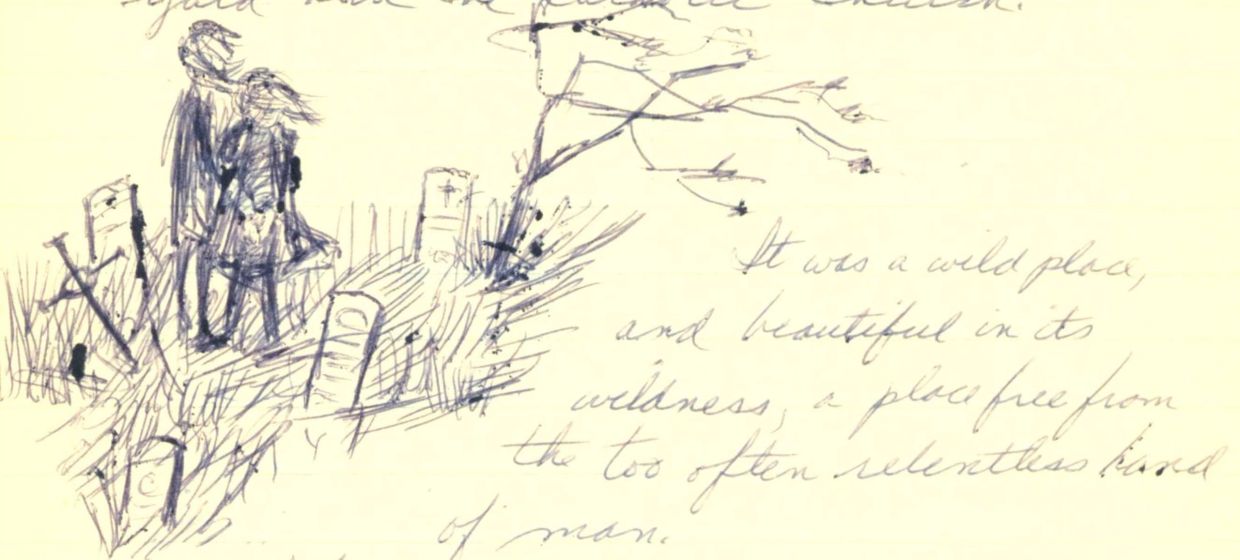
KC's entries continue on August 20th, 1968 (see next page)
It was a wild place,
and beautiful in its
wildness, a place free from
the too often relentless hand
of man.
This website uses cookies.
We use cookies to analyze website traffic and optimize your website experience. By accepting our use of cookies, your data will be aggregated with all other user data.